Month: July 2004

  • The government has issued itself a report suggesting that maybe the whole color-coded warning system for terrorist alert isn't working so well. I'm glad that they have noticed.


    This is a silly system. It tells us, as far as I understand it, how scared we should be, on a scale of one to five. I went to the Homeland Security website to find out exactly what action is suggested at each level, so I know. At blue we should buy duct tape, at orange we should make sure we have enough duct tape, and at red we should call our workplaces and find out whether to take the day off. At some unspecified point we will use duct tape to attach plastic sheeting to all our windows, doors, and vents. This is, of course, the special plastic sheeting that allows in oxygen, but not whatever it is that we are supposed to be afraid of. This plastic sheeting maneuver is never connected with any level of fear, however. It is a separate illustration, right next to the advice to make sure everyone has coins with which to call one another. This is advice for communities which still have pay phones. These are probably the same communities that have the special plastic sheeting. Elsewhere the plan suggests that we find out what kinds of emergencies we are most likely to have. Perhaps we determine this by calling our most suspicious neighbors on the nonexistent pay phones and asking them just what kind of terrorist activity they're working on right now.


    What kind of system is that? The most active thing we ever get to do (aside from buying duct tape and then checking on it repeatedly) is to practice alternate routes to school. Reporting suspicious activities is not active enough to count. Note that I am not complaining about how useless all this is. I don't know that home front activities were ever directly useful. But the current crop of recommended home front activities are silly. Shop? Check on your emergency supplies? Look around for suspicious behavior?


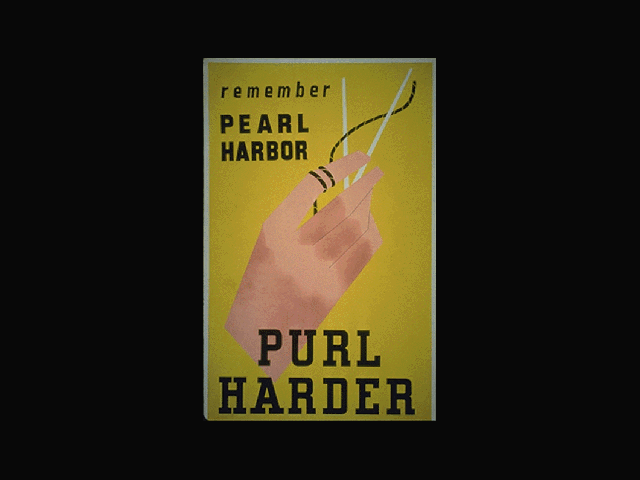
    During WWII, people were given worthy tasks. They planted Victory Gardens, gathered up scrap metal, baked cakes without eggs.  Everyone got to work knitting socks for soldiers. (I don't quite get the egg bit, but I'm sure there was something to it.)They probably felt better. They felt that they were doing something to help. They felt safer because they had cabbages in the back yard and plenty of socks. Do we feel safer when we collect duct tape and watch our neighbors in case they do something suspicious? Hardly!


    And what kind of poster is that going to make? "Be Vigilant!" or "Check Your Duct Tape Supplies!" or possibly "Have You Found An Alternate Route?"  No one is going to admire those in 2050. We won't even have any good reminiscences. We'll sit down surrounded by our great-grandchildren and tell them how on orange days we worked hard to feel slightly more vigilant than we had on yellow days. I don't think so.


    Go on! Plant a Victory Garden! Knit some socks! Don't bother trying to achieve the level of fear appropriate for the color of the day, just pick up your spade and your knitting needles and do something patriotic!


    I have completed the neckband. I think I will have enough yarn left, after I finish the sleeves, to make some socks. I also have a garden. I may not have access to a pay phone, and I may not have the magic plastic sheeting, but I think my approach will work just as well in case of a terrorist attack, and at least I don't have to try to color-code it.

  • The Wall Street Journal reported yesterday that the food pyramid is on its way out. I remember the Seven Food Groups, and then the Four Food Groups, and then came the Food Pyramid. The Seven Food Groups separated out Green and Yellow Vegetables and Citrus Fruits and Tomatoes and gave Butter its own separate group. The Four Food Groups put everything back together, so that folks could delude themselves into thinking fries and ketchup met the whole fruit/vegetable requirement . The Food Pyramid was supposed to show that some foods were more important than others, just in case there were people who got confused and ate as much butter as they did Green and Yellow Vegetables. #2 daughter says this won't work -- if you eat peach pie, as we did yesterday, you can then just decide to eat a LOT of bread to even out your pyramid.


    The interesting thing about the coming demise of the Food Pyramid is the reason for it: it doesn't work. That is, it doesn't change the way people eat. As #2 daughter points out, it is only a picture. "Now if it had electrodes..." she says. She is probably right.


    At our house, we are making efforts to eat in a healthy fashion. The doctor got threatening about my triglycerides at my last appointment, so we try to follow the Golden Rule as put forth in the book Healthy Foods: down with saturated fats and simple carbohydrates, up with fresh produce and whole grains. Except of course for Chocolate Nemesis, which is a health food.

  • I happen to live in the same town as Joan Hess, the town which she has used as a model for Farberville in her Claire Malloy mysteries. This means that I have a very clear mental image of the geography as I read. People who live in London, Manhattan, or Chicago often have this experience, but it is rare for someone who lives in a little town like -- ahem -- Farberville. While reading The Gunseller, I enjoyed people going hither and thither in Prague, Belgravia, and Casablanca, but I didn't really have any sense of where they were or how they were travelling. When I read about Farberville, I can see the characters strolling on the lawn by Old Main and driving down the main street. If they then head up to the mall, I know exactly the route they are taking. While reading about the gunsellers, I could visualize them in their well-described scenes, but then they had to flit through mental ether to their next well-described scene, because I simply don't know what there is between the square and the hotel.


    Not that it bothered me. I have heard of people who use maps -- there are, I believe, special maps of London, for example, for this purpose -- while reading mysteries. They are doubtless the same people who use pins when they measure their knitting. And follow patterns precisely. I sort of admire them, but I am also a bit sorry for the people they live with. I imagine them all as fastidious, fussy people who spend a lot of preparation time before they do anything. I figure that I get a lot more done, and am also more fun. This is probably a delusion on my part. Because I also sort of pity people who are much less precise than I am. I imagine that they live lives of squalor and tension, since they are unable ever to find their cabling needles, even when they look for them. I figure everything in their lives is complicated and exhausting because they are never prepared or organized. So I have essentially determined that there is a perfect level of organization and precision, right between perfectionism and disorder, and defined it as my particular spot on that continuum. I guess this is a harmless delusion, as long as I don't try to make anyone else change to match me. I can just be quietly and completely privately smug.


    Well, I did not get around to casting on the sleeves last night. I am still working on the neckband. This is where the pattern and I will diverge (again). The pattern says to knit k2p2 rib for 1 3/4 inches. Some knitters will pull out their knit gauges and measure the 1 3/4 inches. But my grandmother taught me to double the length of the ribbing at the neckline and fold it and sew it. This gives you a much nicer finish. And -- here is the special trick -- you reverse the pattern on the second half. So at 1 3/4 inches (or thereabouts, depending how it looks) I will switch to p2k2 for another 1 3/4" or so. This will give you a really nice neckband, and no one will be examining your cast-off. What level of precision does it require to examine other people's casting off, and perhaps sneer about it? Probably about the same level that requires a map while reading novels.


    To return to Out on a Limb vs. The Gunseller, it occurs to me that the nature of the stories might make a difference to the familiarity of the location. The Gunseller, being filled with blood and gore and international intrigue, might not seem homey and familiar even if I lived in Belgravia and wintered in Casablanca. I probably wouldn't spend much time on roofs, after all, watching for helicopters. If there were a similar tale set in Farberville, it likely would not happen on the lawn of Old Main. James Bond would probably look for a totally different location, maybe a place I  would not be familiar with at all. Because, when you get right down to it, I spend no time at all in any outposts of the military-industrial complex.

  • This is a picture of #1 daughter's fruit tart. It features a crust made with Bordeaux cookies, a cream cheese, lemon juice, and whipped cream filling, and a lovely variety of fresh fruit on the top.


    #2 daughter makes an equally wonderful dessert called "Chocolate Nemesis." We think #1 daughter's dessert deserves an equally cool name, but haven't come up with one yet. "Fresh Fruit Redemption"? "Fresh Fruit Exaltation"? These ideas came from our search for antonyms for "nemesis." Although #2 daughter maintains that the Nemesis is a health food, #1 daughter's creation seems more innocent, somehow.

  • I have finished the front and back of Siv and grafted the shoulder seams. I measured, checked the pieces against my favorite finished sweater, and tried it on. Satisfied that I was okay thus far, I picked up the stitches for the neckband.


    I did some house and garden work yesterday, made some Pico de Gallo from our garden produce, and caught up on the laundry, but spent most of the afternoon and evening knitting. It helps that The Gun Seller is a quality paper rather than a mass paper (as we say in the trade) and is therefore more inclined to lie flat.


    Hugh Laurie is the guy who played Bertie Wooster on the BBC "Jeeves and Wooster". Clearly, P.G. Wodehouse has sunk into his consciousness. The Gun Seller is what might have resulted if P.G. Wodehouse had written for James Bond instead of for musical comedies. I expect that Hugh Laurie gets sick of hearing that, but the chances of his reading this are so slim that I don't think that need worry me. As a lifelong Wodehouse fan, I think it is a huge compliment.


    #2 daughter headed out for the big city yesterday and #2 son is still at the Summer Institute, so it was mostly just me and #1 son at home for the afternoon. He is an excellent model for sluglike lassitude. Our fingers -- mine knitting and his playing video games -- were all that moved.


    After work, I intend to cast on for the sleeves. In the course of yesterday's cleaning, I found the cabling needle. Even so, I haven't decided whether to put cables on the sleeves or leave them plain. Plain stockinette leaves plenty of attention for reading. And it is hard enough to get the two sleeves identical without adding in complex cables.On the other hand, the pattern was written with cabled sleeves. Surely that should count for something.

  • I'm finished with the back of Siv, and nearly finished with the front. I'm doing the shaping now, so I have to pay attention. This is the point at which I determine whether the sweater fits or not. So there is a lot of counting and measuring required.


    Lavold (the designer of the pattern) recommends measuring the pieces while they hang in the air. This, she says, is how the sweater will be worn. This sounds very reasonable until you actually try it. You can try it right now. Go ahead, get a sweater and hold it up in one hand. As it dangles there, pull out your tape measure and check the distance from the beginning of the armhole to the shoulder. You will find that this is impossible.


    Knitting geeks usually lay their pieces out, put pins in them at strategic points, and measure between the pins with a ruler. They also make schematics before they begin knitting, and calculate the correct measurements and stitch counts at each point. They have rulers, measuring tapes, and knitting gauges handy in their knitting baskets, too.


    I am not a knitting geek. Remember, I am the one who hasn't bothered to find the cabling needle. But of course I believe in measuring. I just use a more old-fashioned system. I know that the first joint of my index finger is about 1". The first two joints make 2". If I hold my hand in an L shape, it is about 4" from the beginning of my thumb to the tip of my index finger. From the tip of my thumb to the tip of my little finger, well stretched, is 8". So I can do a lot of measuring without actually having to get up and find some official tool for measurerment.


    I think this is handy. Everyone should check out the basic measurements of their hands so they can do this. You can estimate most measurements under a foot in this way. You can also estimate the measurement of your foot -- it's about the same as the distance from the crook of your elbow to your wrist. So you can check the progress of socks as you knit them, without having to take off your shoes. If you stand with your arms outstretched, the span from one fingertip to the other is about your height. And if you hold a closed waistband up and wrap it around your neck, you can quickly estimate whether the garment will fit you or not. People will think you are odd, but it works.


    I have no tips on quick estimates of volume. #2 daughter and I went  to the farmer's market yesterday. Our own garden is filled with lovely tomatoes, peppers, melons, squash, and herbs, but one cannot live on these things alone. We also need blueberries, peaches, and green beans. So there we stood at the stalls, keeping the farmers waiting while I tried to guess how much of each thing we might need. Quick, visualize a pie and calculate the number of peaches needed for said pie. Then add on the number of peaches that will be eaten before we get around to making the pie. It's even harder with blueberries, because the dogs eat those, too. On the other hand, you don't have to do any mental switches from big round fruit to slices, when you are figuring in blueberries. On the third hand, you do have to consider the need for making blueberry pancakes, plus the random eating of handfuls for berries, and feeding them to the dogs, before anyone actually makes a pie. The best plan is just to buy lots and lots, because after all who knows?


    This is a popular approach for the buying of yarn as well. It would seem that people who calculate and measure as much as knitters do would be able to buy the right amount of yarn with perfect confidence. You can weigh a sweater made with a similar yarn, and buy the same number of ounces. You can keep careful notes and buy the number of skeins you have used for this kind of yarn in the past. You can even use the number of skeins suggested in the pattern. And yet most knitters buy way more yarn than they need.


    It may be because it is hard to estimate volume, even though no one will be eating the yarn before you get around to making the sweater. Estimating weight is tricky, too. I really only know of two good landmarks for this: first, the average cat weighs about 8 pounds. Second, you can send 4 quarters for the price of one stamp. Neither of these pieces of information helps much with a sweater, even if you intend to make a sweater for a cat and mail it. But I think the most likely explanation is that we like to buy yarn.


    There is a yarn shop near the Farmer's Market. #2 daughter and I parked directly outside it, even though I do not need any yarn until I finish Siv. We finished our vegetable and fruit purchases and got back to the car just five minutes before they opened. We loitered around a bit, and even went up and peeked through the window in hopes that the yarn ladies would open early and let us in. No such luck. It didn't seem reasonable to stay there in the heat with a car full of produce just so we could go in and touch a lot of yarn we had no intention of buying, so we went on home. Sigh.

  • Chanthaboune says she can't read and knit at the same time. I'll bet part of that is the fact that it is hard to keep the book open while you read. I am currently reading Lemon Meringue Pie Murder, a paperback, while knitting the complex cable-patterned Siv from Viking Patterns for Knitting. It is a challenge to cable while holding open a paperback, especially if you are too lazy to get up and find the cabling needle. You have to do things like balancing the book in your lap and holding it open with your elbow while knitting with both hands, possibly missing the last two lines of each page where your elbow covers the words.


    Publishers should make special spiral-bound versions of all their books for knitters. Then the book would politely stay open while we knit, making the whole thing much easier. Until they do, many knitters will have to make do with watching movies or TV instead of reading while they knit.


    I am watching "Sex and the City." I didn't see it the first time around on HBO, so I am catching up by watching it two episodes at a time on TBS. This is especially appropriate for a cyberknitter because the online magazine, knitty, is calling its current issue "Sex and the knitty"http://www.knitty.com . If you have ever wanted to knit yourself a garter belt or a specially pretty nightie, you can go to the link and find a pattern. You can also read some rather unconvincing articles explaining what knitting and sex have in common. My own feeling on this is that no activity involving sharp sticks should be attempted in conjunction with sex.


    "Sex and the City" is a well-written, well-acted, well-made saga about four apparently intelligent women who act like sluts and then regret it. Over and over and over. They have many excuses and explanations for why their lives don't work out the way they want, none of which include the fact that they act like sluts. This is interesting, because the writers apparently are doing this on purpose. Many TV shows show what seems to me to be irresponsible sexual behavior, but present it as normal and even positive behavior having no negative consequences. That is not the case with "Sex and the City."


    For example, in one episode the narrator is mistaken for a prostitute and is upset by it. She has slept with a complete stranger and been paid for it, which the viewer can immediately recognize as something characteristic of prostitutes. The writers don't fool around with it and offer some kind of back story or extenuating circumstance, they just lay it out. But the character doesn't notice the source of her problem. She seems to think there is something about popular culture, or the man in question, or possibly about New York, that has caused her innocent behavior to be misinterpreted. In this, and in other episodes as well, the women are portrayed as having hurt feelings, uncertainties about themselves, and various other forms of angst, all immediately and obviously traceable to their dumb sexual choices -- but they don't realize it. It will be interesting to see whether the characters ever, at any point in the series, consider that maybe they are being treated like sluts because that is how they behave.


    In any case, it won't interfere with your cabling.

  • I like to read while I knit. Or perhaps it's that I like to knit while I read. If  I'm knitting, after all, then I'm not wasting time, no matter how frivolous my reading.


    My Grandmother Hazel, who taught me to knit, also read while she knitted. She read mystery novels (as I do) and also the historical sagas of people like John Jakes. I like a good historical novel myself, but never John Jakes. I actually have some good medieval ones on the shelves; maybe I should read one of them next, to infuse even more Viking spirit into my sweater.


    Grandmother Hazel really only knitted one pattern. She did a top-down, no-seams raglan on circular needles, picking up the sleeves on circular sleeve needles after the body was finished. She had a leaflet that gave the directions to make this sweater in every size and every gauge, as a cardigan or a pullover. She made them in tiny cotton thread with a matching skirt for a Chanel-type suit, in worsted for a winter sweater, and everything in between. She never used pattern stitches or color work, although she did a lot of dressmaker details like pockets and attached scarves.


    I once had a copy of that leaflet, and I made a few of those myself. But we have so many of Grandmother Hazel's around the house that I will probably never make another. After all, hers are just about perfect. You make essentially the same sweater for a decade or seven and you are going to get very very good at it.


    That's not how I approach knitting. I like to do different things every time. I rarely follow a pattern exactly. I love to try out new things -- like Viking knitting. I would rather do something difficult and interesting than repeat something until I perfect it.


    This does mean that reading sometimes slows me down. Siv is a complicated cable, and when the book gets interesting, I sometimes find myself holding Siv in suspended animation for a while, until I wake up and notice. Then I knit steadily until the next plot crisis.


    I have finished the back of the sweater and am about an inch from the armhole shaping on the front. And the first body has just been discovered in The Lemon Meringue Pie Murder.

  • We are suffering from summertime lethargy here.


    Well, perhaps not suffering. Maybe we are enjoying it. It is something like the book The Napping House, "where everyone is sleeping." We aren't really all sleeping all the time. I am going to work every day, after all. My husband has the week off and is sleeping so late that I never see him before I leave, but I have reason to believe that he wakes up at some point in the day. #2 daughter has a job as well. But she doesn't start work until 2:00 pm and I don't start till 10:00 am. She sleeps in, and I probably would, too, if I didn't suffer from insomnia. #1 son doesn't have a job, and his Summer Project is "Getting Taller," so he doesn't get up very early either. The dogs snooze all the time.


    The crux of the matter is that, when we aren't sleeping, we aren't doing much else, either. #1 son is conserving energy for his Summer Project, so he lies, sluglike, playing video games for most of the day. Occasionally he rouses himself to shoot some hoops, but mostly he lolls about. #2 daughter and I go to the gym most days. This involves an hour of my working at dragging her out of bed. We only work out for 45 minutes, so there is more time spent on persuading her to get up than actually exercising. Otherwise in the mornings I play around on the computer, read, and think about all the house and garden work I am not doing. In the evenings, we watch TV, knit, do a crossword puzzle, read .... sometimes the kids go out with friends and #2 daughter and I are practicing our music a little bit, but mostly we loll around.


    In late spring and early summer we did a lot of things. We planted a lovely garden, kept it weeded, made things with the herbs from it. We made soap, mixed up shampoo and bubble bath with our own scent blends. We baked, redecorated, quilted, went to the Farmer's Market. I did the laundry and cleaned. We played games, had friends in, vigorously debated the merits of #2 daughter's various dates.


    All that is past. Now I cable without my cabling needle because I am too lazy to go look for it. We watch TV. We give up the crossword by Wednesday when it starts getting difficult. We have pizza delivered because it is too much trouble to cook. Or even to decide on something to cook.


    I have always insisted that the kids have Summer Projects. The point of this was to make sure the summer months weren't entirely wasted. Now #1 daughter is married and living far away and I don't know whether she is making good use of her time or not, but it is no longer my problem. #2 daughter is working, so she is exempt from all other projects. #1 son is "Growing Taller." That is his project. Naturally, this involves eating a lot and avoiding the effects of gravity by lying down as much as possible. #2 son is at the Summer Institute, doubtless working hard and being a credit to his family -- but that is like our going to work. Or the gym. It takes place outside the house. In the house, we are all lolling.


    Is this wasting the summer months? Outside, it is like a sauna. The bees sound drowsy. In the fall, we will all scurry around, making apple butter and getting plenty of warm woolies ready for the winter, filling the freezer with Christmas cookies and learning all our recital pieces. Maybe now is a good time to loll.

  • I am working on Siv, from the book Viking Patterns for Knitting by Elsebeth Lavold. I am using the cable chart from page 22, rather than the one from page 19 as the directions say, since the pattern begins on page 20. I -- I think naturally -- used the chart that followed the picture, rather than one that appeared to be from the previous sweater. But it is characteristic of this book that it would do something so counter-intuitive as to give the pattern chart before the sweater pattern. It also requires you to learn a new charting system and new stitches. Never mind. The sweaters are beautiful. The pattern chart I am using is based on a design found on a harness plate in Stavanger, Norway, and a bone fragment in York.


    The entire book is based on the notion that, had Vikings knitted, they might have used the same kinds of motifs in their knitting as in their other decorative arts. Lavold figured out how to use cables to recreate Viking motifs, and in the process designed a bunch of gorgeous sweaters. The sweaters are embedded in a book about archaeology, Vikings, sword hilts, Norwegian chairs, etc. Lavold assures us that knitters need "more systematic research." I am not at all sure that knitters need systematic research, but she has certainly provided some, whether we need it or not. And her patterns are amazing.


    This is not my first Viking sweater. I made one before, using a sweater pattern from Big Fish, Little Fish and the chart for St. John's cross. I made it from a wonderful New England wool, deep indigo with slubs of various bright colors. My husband washed and dried it in the machine. Once I recover from the trauma, I intend to finish felting it and make some cushion covers or something. However, I am using Woolease sport weight for my new sweater, just in case.


    I am not a yarn snob. Nonetheless, I think there is no point in putting in hours knitting (especially hours and hours doing Viking patterns) and ending up with something that will not last or look good. So I believe in using good quality yarn. And I think Woolease is a good quality yarn, on the basic end of the spectrum. I found the stuff I'm currently using at half-price and bought it all up. It is a soft green, and I had originally thought I would use it for a spring sweater, probably a Fair Isle. I made it up using a "plus-size" pattern which turned out to be designed for a gorilla rather than a buxom woman, so I frogged it and started again. Surely the Vikings would have been equally frugal and resourceful, had they had any Woolease or any idea of knitting it.


    My youngest is off on a Summer Institute in which he will study trebuchet physics and build medieval siege weapons. The older boy is spending his days playing a MMP online fantasy game in which he takes on the character of a somewhat medieval warrior. My eldest is doing the same while her husband is on the night shift. And I am knitting a Viking sweater.

Recent Posts

Recent Comments

Categories